
Give Bible genealogies a manageable first reading
Bible genealogies can interrupt the reading rhythm you have just found. A scene becomes a sequence of unfamiliar names, and you wonder whether anything will be lost if you move on. Begin with a smaller goal than mastering the whole family history: follow the relationships in a short section and describe how the list is written.
You need a Bible, a spare piece of paper and enough time to read a few verses twice. Choose one passage rather than collecting every genealogy at once. Record its reference and translation, then leave three spaces for the line you follow, the wording that repeats and the detail that receives extra attention.
This guide works through Genesis 5:1–8 and Matthew 1:1–6. The first offers extended entries about successive lives; the second places shorter relationships within an introduction to Jesus. They are separate exercises, not an attempt to combine every list. For a wider introduction to the first book, begin with reading Genesis with care.
Find the beginning and end of the list
Read the sentence before your chosen list and the sentence after it. Notice whether the opening identifies a person, family, group or new stage of a story. The placement may help you ask why these relationships appear here. A chapter heading supplied by an editor can orient you, but distinguish it from the actual sentences of the passage.
Mark a small working range and acknowledge when it is only part of a longer list. Genesis 5:1–8 does not reach the chapter’s final generation. Matthew 1:1–6 does not complete Matthew’s genealogy. Our limited ranges allow careful practice; they should not be described as complete accounts of either chapter.
Then read once without drawing anything. Let an unfamiliar name remain unfamiliar for the moment. Say it as best you can, or follow it silently with a finger. If uncertain pronunciation slows you down, use the printed sequence as your guide. Understanding which name connects to the next matters more here than giving a polished public reading.

Follow a line before drawing a tree
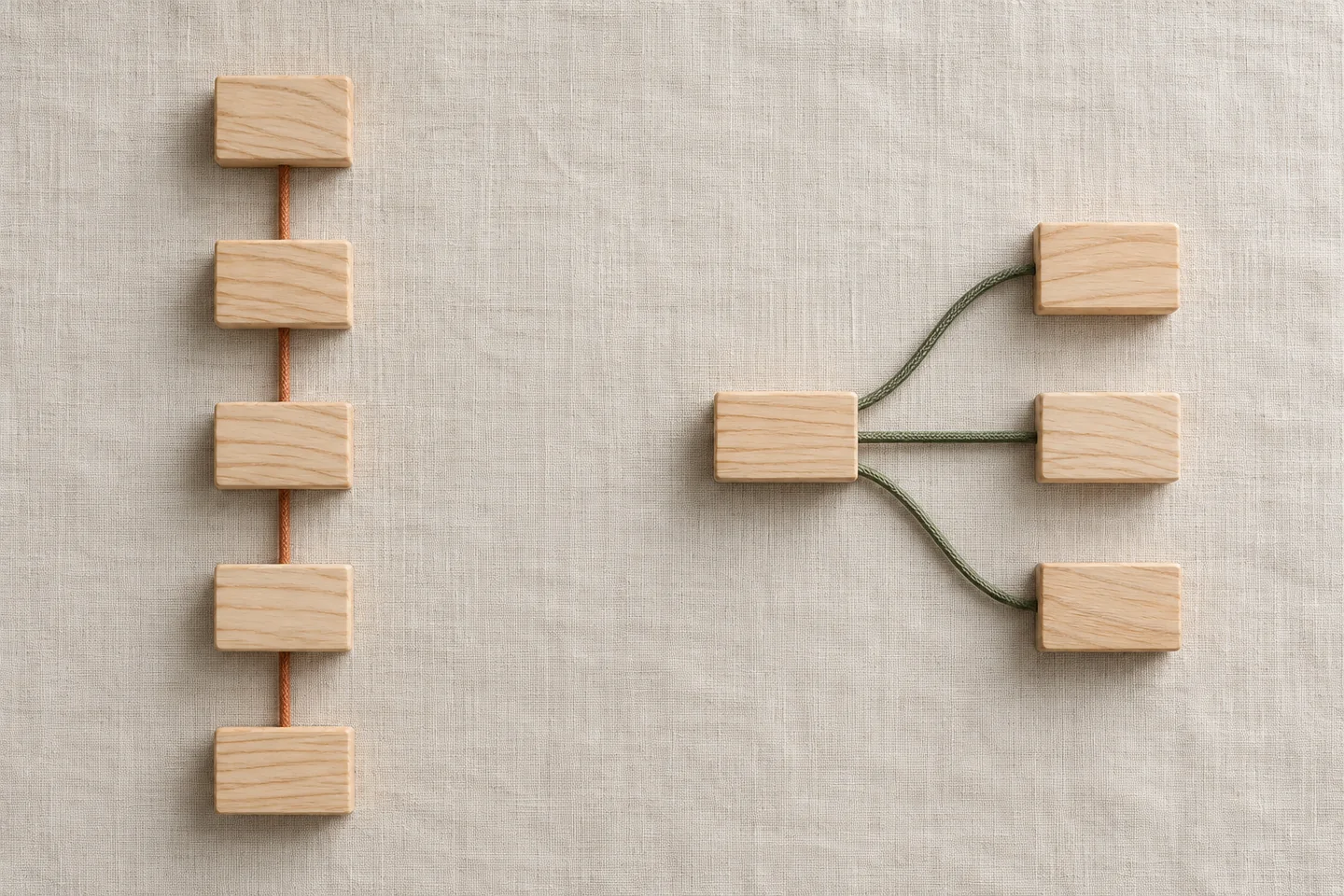
Ask what shape the relationships take. Does the text follow one person into the next named generation, or present several children and their branches? A modern family tree spreads across a page, but a written list may be following a narrower path. Begin with that path before making a diagram that suggests more information than you have.
Draw a short vertical line of names, with the verse reference beside each connection. Add a branch only where the text supplies it. When other sons, daughters or siblings are mentioned without names, preserve that statement in a note. Do not fill empty places with names remembered from a different chapter.
For example, a named successor does not make every other child disappear. A list can tell you which connection it follows while also acknowledging a larger household. Your drawing is an aid to reading, not a replacement for the words. If it becomes crowded, stop drawing and write one plain sentence about the relationship instead.
Hear the repeated formula
On a second reading, listen for the recurring sequence of information. Some entries include a person’s age, a named descendant, further years, other children and death. Others consist mainly of connected names. Note the order of the information before deciding what its repetition means. Numbers and names deserve attention, but they need not turn immediately into a calculation.
Write the recurring structure in your own words, clearly labelled as your summary. Then ask whether the next entry follows it exactly. A brief change may be easier to notice once the ordinary rhythm is familiar. Avoid assigning a separate spiritual message to each repeated phrase simply because repetition feels significant.
For extended study, BibleProject’s Adam to Noah course places Genesis 2–5 within a Christian reading of the book’s literary design. It is an interpretive teaching resource, not the wording of Scripture. You can first make the simple observations below without completing the course or adopting every larger conclusion it presents.
Genesis 5:1–8: read two entries carefully
1This is the book of the generations of Adam. In the day that God created man, he made him in God’s likeness.
2He created them male and female, and blessed them. On the day they were created, he named them Adam.
3Adam lived one hundred thirty years, and became the father of a son in his own likeness, after his image, and named him Seth.
4The days of Adam after he became the father of Seth were eight hundred years, and he became the father of other sons and daughters.
5All the days that Adam lived were nine hundred thirty years, then he died.
6Seth lived one hundred five years, then became the father of Enosh.
7Seth lived after he became the father of Enosh eight hundred seven years, and became the father of other sons and daughters.
8All of the days of Seth were nine hundred twelve years, then he died.
Read the displayed passage before looking at the sample note. Its opening recalls creation, likeness and blessing before the entries about Adam and Seth. Notice that the list begins with more than a chain of names. Keep that introduction attached to your description of the passage.
Worked note: Genesis 5:1–8 connects Adam with Seth and Seth with Enosh. The entries about Adam and Seth each include further life, other sons and daughters, total years and death. My small diagram follows the named line; it does not represent every child mentioned. The opening also frames the list through creation and likeness.
Bounded conclusion: These verses present successive lives through a recurring structure. They do not provide the personal stories of all the unnamed children. My next question is how the pattern continues later in the chapter, not which missing details I can supply from imagination.
Check each sentence against the numbered verses. If your translation spells Enosh differently, keep its spelling in your own note. Do not silently rewrite the displayed text to make different editions match.
Matthew 1:1–6: notice the added descriptions
1The book of the genealogy of Jesus Christ, the son of David, the son of Abraham.
2Abraham became the father of Isaac. Isaac became the father of Jacob. Jacob became the father of Judah and his brothers.
3Judah became the father of Perez and Zerah by Tamar. Perez became the father of Hezron. Hezron became the father of Ram.
4Ram became the father of Amminadab. Amminadab became the father of Nahshon. Nahshon became the father of Salmon.
5Salmon became the father of Boaz by Rahab. Boaz became the father of Obed by Ruth. Obed became the father of Jesse.
6Jesse became the father of King David. David the king became the father of Solomon by her who had been Uriah’s wife.
Begin with the opening description of Jesus and then follow the line from Abraham. Matthew’s first verse already names David and Abraham. As you read onward, notice where the sequence includes brothers, women or a title. Preserve those additions rather than reducing every verse to two male names and a connecting line.
Worked note: Matthew 1:1–6 introduces Jesus through David and Abraham, then traces a sequence beginning with Abraham. The list mentions Judah’s brothers, names Tamar, Rahab and Ruth, calls David king and refers to Solomon’s mother through Uriah. These are features I can point to in this passage.
Bounded conclusion: This opening does more than record an uninterrupted row of identical entries. Certain relationships receive extra description. To understand a named person’s story, I need the relevant narrative; the list alone is not a biography or a complete moral assessment.
Reread the final connection in your chosen range slowly. A description can preserve a relationship that an oversimplified diagram would erase. Keep the wording’s focus visible while leaving questions about its wider significance open for further reading.
Pause where the pattern changes
Choose one addition and ask what further reading it invites. Ruth’s name, for instance, gives you a concrete route into the book of Ruth. Read that story on its own terms before bringing an observation back to Matthew. A familiar name is an invitation to check a connection, not permission to attach every remembered interpretation to the list.
Separate two questions: what detail has been included, and why might it matter here? The first can often be answered directly from the selected verses. The second may require the rest of the chapter, another narrative or a careful commentary. Write the answers on different lines so an interpretation does not quietly become a quotation.
Resist treating every unnamed person as unimportant or every named person as exemplary. Inclusion in a family sequence does not, by itself, approve every action in that person’s story. The text can connect people without making their lives interchangeable. The textile image illustrates attention to a variation; it supplies no hidden meaning for the genealogy.

Keep the limits of your observation visible
Do not turn a first reading into a complete chronology. Questions about ages, generations, textual witnesses and the relationship between lists require more evidence than one short diagram. You can record a number accurately while leaving its relationship to broader historical questions unresolved. An unanswered question does not invalidate the observations you have already checked.
Likewise, avoid treating a family line as a ranking of human worth. A genealogy serves the particular work of its passage. It does not authorize contempt toward people outside that line, or tell a present reader that an uncertain family history makes them less valuable. Do not force another person’s adoption, estrangement or loss into a tidy illustration.
If you consult a commentary, note its author and interpretive setting. Christian traditions may explain the theological importance of a genealogy differently. A resource’s confident conclusion remains something to examine. Ask which verse supports the claim and which additional assumptions are required; preserve that distinction when discussing the passage with someone else.
Write a note that another reader can check
Keep your final note short enough to verify. Write the reference and translation first, then one sentence about the line followed, one about a repeated feature, one about an addition and one open question. This gives a future reading a clear starting point without creating an elaborate chart you cannot maintain.
For Genesis, you might return to later entries and test whether your description of the pattern needs revising. For Matthew, you might read the rest of the genealogy and its transition into the birth account. Name the next passage rather than making an indefinite promise to study every person.
Read your note aloud while another reader follows the passage, if they would like to help. Ask them to identify anything your summary adds or leaves out. Our guide to reading a verse in context offers a wider check on that movement from observation to interpretation. Keep corrections beside the reference so they remain easy to revisit.

Finish with a practical reading check
Before closing the book, check five things. Have you identified the range you actually read? Can you follow each named connection without inventing a branch? Have you preserved repeated information and important additions? Can another reader find the evidence for your summary? Have you named a question that needs further reading rather than presenting it as solved?
Then look at the passage without your diagram. Notice whether an opening sentence, unnamed household members or a descriptive phrase has vanished from your memory. Add it back to the note if it changes the account you gave. Your drawing should become more accurate as you read, not something you must defend against the page.
You may finish knowing only a small part of a longer sequence. That is a workable result. A list that once felt like an obstacle now has a beginning, a pattern and relationships you can follow. Next time, continue from the reference you saved and let the next section test what you have learned.
Questions about genealogies
Do I have to memorize every name?
No. Begin by following the relationships and noticing the list’s shape. Memorization is a separate goal; it is not required for a careful first reading.
Can I skip unfamiliar pronunciations?
Follow the names silently if needed, or read them as best you can. Keep their order and connections intact. Uncertain pronunciation need not stop you from understanding a short passage.
Does a genealogy give a complete family tree?
Do not assume that it names every family member. Read what the particular list includes, including references to unnamed children or siblings, and leave missing information unfilled.
Can I calculate a complete timeline from this exercise?
No. This exercise identifies features in two short passages. A wider chronological argument needs additional textual and historical evidence and a clear account of its assumptions.