
Read Habakkuk 3 without hurrying to its last sentence
How does Habakkuk 3 reach joy while the fields it describes still yield no food? Read the prayer from its opening request through the powerful middle images and into the trembling voice at the end. The final words of trust belong beside those details. The chapter does not insert a new harvest between the list of losses and the speaker's rejoicing. Keeping that sequence visible helps you read the closing verses without turning them into a promise that your circumstances will improve on a particular date.
For a first reading, give the whole chapter one unhurried sitting. Notice where the speaker addresses God and where the speaker describes what is happening within himself. Leave the difficult middle images in the reading even if you cannot explain every detail. You can return to them with a more precise question later. Begin by naming what each part contributes to the prayer rather than selecting an encouraging ending and asking the rest of the chapter to disappear behind it.
Use the chapter study guide to keep the whole reading in view.
Find three movements in the prayer
Use three brief headings in a notebook: opening appeal, powerful coming, closing voice. Place verses 1–2 under the first, 3–15 under the second and 16–19 under the third. These are reading aids you can adjust as you look more closely. Under each heading, write one action you can locate in the text. The first addresses God and asks for renewed work. The middle pictures movement and power on a large scale. The close gives you trembling, a list of absences and words of joy.
The Catholic USCCB edition provides notes on the chapter's prayer and musical framing. Compare that guidance with the beginning and end of the edition you are reading. You do not need to settle every technical term to notice that this is a shaped prayer. A helpful first summary can remain simple: the speaker appeals to God, describes God's powerful action and speaks from a position of fear and trust. Keep the verse ranges beside that summary so you can test whether it has left anything important out.
Consult the Catholic USCCB edition and notes on Habakkuk 3.
Worked reading: what is heard and what is asked
1A prayer of Habakkuk, the prophet, set to victorious music.
2LORD, I have heard of your fame. I stand in awe of your deeds, LORD. Renew your work in the middle of the years. In the middle of the years make it known. In wrath, you remember mercy.
3God came from Teman, the Holy One from Mount Paran. Selah. His glory covered the heavens, and his praise filled the earth.
Read Habakkuk 3:1–3 in the World English Bible. In verse 2, distinguish what the speaker has heard from the response to what was heard. Then identify the request for God's work to be renewed and made known. Notice how mercy appears in the same opening address. Write three short entries: what is reported, how the speaker responds and what is asked. This keeps the request grounded in the actual words instead of replacing it with a general statement that everything will soon be easy.
Now write a possible personal response below those observations. You might wish to ask for mercy while remaining uncertain about what lies ahead. Make clear that this is your prayer arising from a reading. You are not reporting a new message spoken to you by God or claiming that the original speaker described your particular event. Check the separation on the page: the passage has its own reference and edition; your response uses your own words. The opening can give you language for a request without fixing the answer's timetable.
Read the middle before explaining the ending
Verses 3–15 move through mountains, waters, light and weapons. Read them slowly enough to hear their force. In verse 13, notice the stated purpose of salvation alongside the violent descriptions. Do not reduce the section to a peaceful landscape just because a landscape makes a convenient illustration for the closing verse. The chapter's prayer includes danger and conflict. Your first task is to observe how those images stand within the address to God, even where you are left with a difficult question.
Choose one detail rather than inventing an explanation for all of them. For example, follow the water references through the middle and note the verbs attached to them. Ask how they contribute to the scale of the scene. If you consult a specialist discussion, keep its proposal separate from what the wording plainly states. Avoid identifying a contemporary person or group as the enemy of this poem simply because you are angry with them. The imagery deserves a reading of its context before any modern comparison is proposed.
Let the trembling in verse 16 remain audible
At verse 16, read the speaker's bodily descriptions before continuing to the familiar ending. Lips, bones and trembling give the reaction a physical vocabulary. The text lets that voice speak after the large images of God's power. If your summary says that the speaker has no fear, return to this verse and revise the summary. A later expression of joy does not remove words already spoken in the same prayer. Both belong in an account of how the chapter moves.
Treat the language as the poem's expression, without using it to diagnose either the speaker or a modern reader. When reading aloud, a brief pause after verse 16 can help you hear the change that follows. It does not need to become a performance of somebody else's distress. Read the words at an ordinary pace and notice which ones you had previously overlooked. If you are taking notes, include the reference beside the physical response so that it remains easy to find when you discuss the closing confidence.
The context reading guide helps keep the preceding sentences beside a final line.
Worked reading: list the absences before the joy
16I heard, and my body trembled. My lips quivered at the voice. Rottenness enters into my bones, and I tremble in my place because I must wait quietly for the day of trouble, for the coming up of the people who invade us.
17For even though the fig tree doesn’t flourish, nor fruit be in the vines, the labor of the olive fails, the fields yield no food, the flocks are cut off from the fold, and there is no herd in the stalls,
18yet I will rejoice in the LORD. I will be joyful in the God of my salvation!
19GOD, the Lord, is my strength. He makes my feet like deer’s feet, and enables me to go in high places. For the music director, on my stringed instruments.
Read Habakkuk 3:16–19 in the World English Bible. Give verse 17 its own row in your notes. List the sources of food and livelihood it names: fig tree, vines, olive, fields, flocks and herd. Next read verse 18 and write down the one in whom the speaker rejoices. Finally, check whether the passage says that the trees, fields or stalls have been refilled between those two verses. Your observation should record the turn toward joy without supplying a scene the poem has not narrated.
Try comparing two summaries. The first says that the speaker rejoices after everything returns to normal. The second says that the speaker voices joy after naming the absences. Which summary can you support with these verses? Point to the exact place that supports your choice. The second stays closer to the written sequence. That does not answer every question about the circumstances; it simply prevents an invented harvest from becoming the reason you give for the final confession. Keep the missing details missing in your note.
Hear what the word yet connects
In the World English Bible, the movement into verse 18 is marked by yet. Read the preceding list and the following statement in one breath, then read them with a short pause. Compare what you hear. The contrast does not require you to make either half less serious. The absences have been named at length, and the joy has a stated object. A careful paraphrase preserves both, instead of replacing the list with a vague suggestion that the speaker had a slightly difficult day.
When applying the passage, distinguish what you can say about the poem from what you can say about yourself. You can describe the contrast in the poem even on a day when you cannot make its closing words your own prayer. You can also choose to pray those words without announcing that every question has been settled. Write the response honestly, with the reference beside it. The text gives the reader a voice to consider; it does not give another person a measure for grading your emotional response.
Read the final image as an image
Verse 19 names God as strength and compares the speaker's feet to those of deer. Keep the comparison in view and ask what movement it describes in the line. Then look back at the instability expressed in verse 16. You can notice the difference between trembling and the closing image of movement without turning the passage into a guarantee of physical ability, safety on a mountain or a particular recovery. The prayer speaks with poetic language, and your explanation should remain proportionate to that language.
If you draw a small arrow between those two references in your notes, label the observations rather than an outcome. One reference gives a trembling voice; the other gives an image of feet and heights. Read the intervening verses again before deciding how you understand their relationship. Another reader may put different emphasis on the image. Ask what wording supports their account. Comparing observations is more useful than insisting that every reader must picture the same modern scene or report the same immediate feeling after reading it.
Read beside someone without directing their feelings
If you read this prayer with another person, agree on the passage before the conversation. Give them time to notice a line, including a line that troubles them. They may hear the appeal for mercy, the disturbing middle images or the list of losses before they hear the joy. Ask where their chosen words sit in the chapter. You can explore that connection together without deciding in advance which verse should matter most to them or what response they should have by the end.
Avoid using the closing words to hurry a person through a difficult experience. A shared reading can leave an unanswered question on the table. If you offer a personal prayer afterward, distinguish it from the biblical passage and do not claim to explain why something painful happened. You may simply return to the opening request for mercy. The conversation can finish with a reference to revisit, rather than a report that fear has disappeared or that a visible result is now guaranteed.
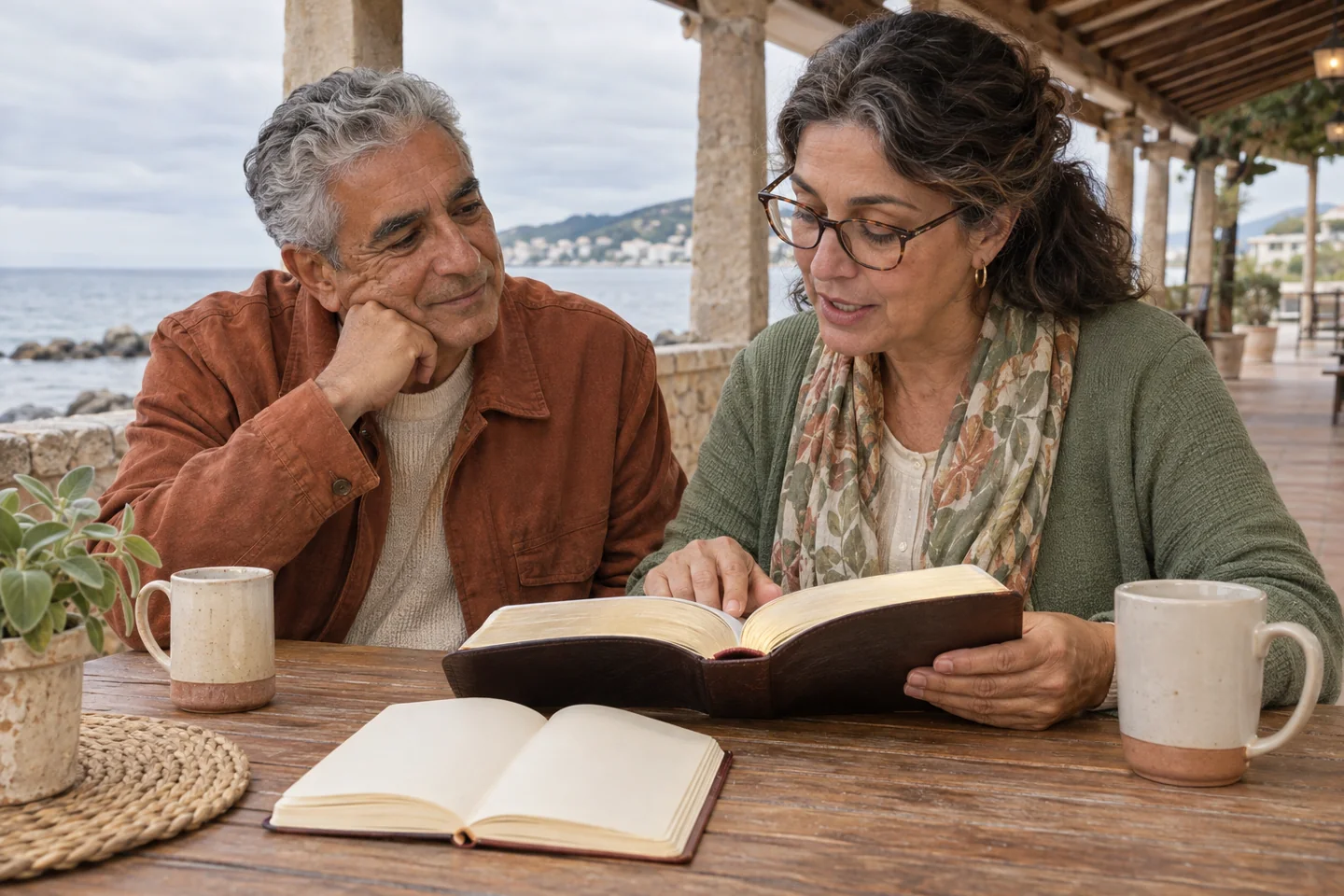
Finish by checking three observations
Close your notes for a moment and locate the opening appeal, the trembling voice and the turn toward joy in the chapter. Can you name one detail from each without blending them together? Reopen your notes and add the verse references. Check that the final summary does not invent a renewed harvest, erase the fear or turn the image of feet into a literal promise about your body. If one of those additions has slipped in, rewrite the summary using only details you can point to.
For a final written response, make two separate paragraphs. In the first, explain a connection between two references in the prayer. In the second, record a question or request you wish to carry from the reading. Keep any hope for a future change separate from a claim about when it will happen. On your next visit, begin with the whole chapter again. Habakkuk's closing prayer can be read with its plea, its difficult images and its joy all present, without requiring the empty fields to become a different scene before the last line is heard.
Questions about the closing prayer
Does the ending describe a new harvest?
The movement from verse 17 to verse 18 does not narrate a restored harvest. Keep the absences and the expression of joy in the same reading.
Why read the middle images too?
The powerful and troubling middle belongs between the opening request and the closing voice. It keeps the final lines in their prayer context.
What if I cannot make the last words my own today?
You can describe what the prayer says and keep your own question beside it. A reading need not become a report that all fear has disappeared.
Why does a heading sound different in another edition?
The displayed passages use the World English Bible wording. Identify another edition when comparing its heading or phrasing instead of blending the two.