
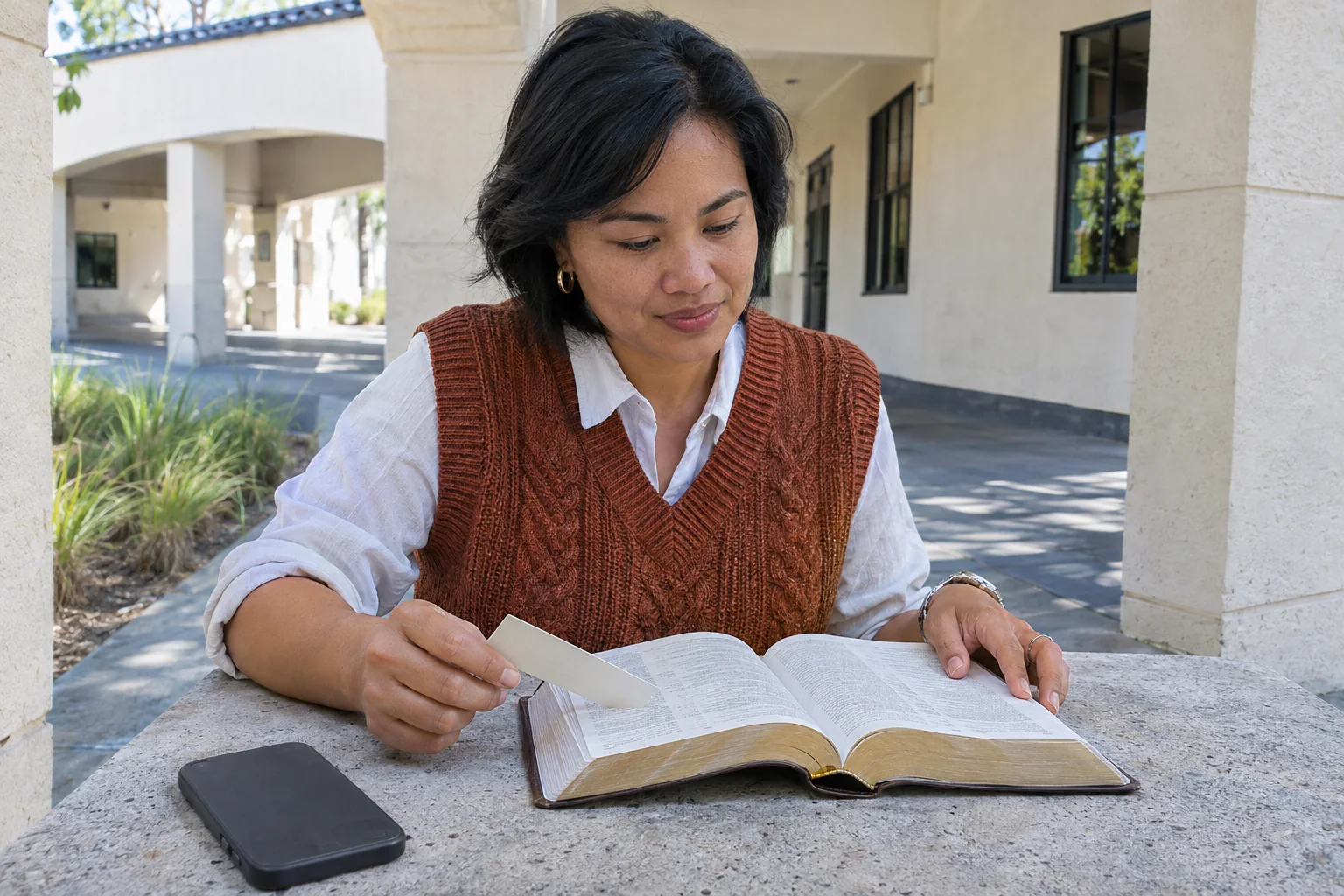
When to search within a Bible chapter
Have you ever scrolled past a verse twice because you knew which chapter it was in but couldn’t see where it started? When you search within a Bible chapter, you work from the passage you already have open. A number can take you back to a line you marked. A short range can gather a few consecutive verses. A word can help locate a detail whose verse number you’ve forgotten.
Set an endpoint before typing. You might want the start of a speech or the sentence immediately before a question. In either case, the search is a route to the text. It helps to know what you need to read after you land. If you are rereading a short chapter on paper, scanning the verse numbers by hand may get you there just as easily. The steps below are designed for either way of reading.
Check the address before you type
Look at the reader’s book name, chapter number and edition. A number on its own makes sense only inside its chapter. If someone says to look up verse five during a discussion, they may still have the previous chapter open. Confirm that you are both looking at the same address before you look for a sentence. Put the full reference at the top of your note, so a number you write below it can still be understood later.
For a word search, the edition matters too. A familiar noun can be expressed differently in two translations. Write the word as your current page has it, including an inflected form if you can see one. Treat section titles and notes as navigation aids. If you remember a term from a title printed above the chapter, go to the heading in the reader. The word may never occur in a verse in that chapter. Plan to verify the result against the running text.
Choose a number, an ordered range or a word
When you know the number, start with the number alone. When you know the first and last verses, put them in reading order with a dash between them. Use a word when the position is the part you’re trying to find. Choose a distinctive object, name or verb you expect to see. A query with lots of words can hide a line that uses a slightly different phrase. The Logos help on search offers a separate example of finding text within a resource. Search controls vary across readers.
Open Chapter overview from the reader in Psalia. Its field is labeled Verse, range or word. The list is built from the open chapter and its current edition. For a text query, the chapter tool looks for every entered search term at the beginning of a word within an individual verse. Keep the query short and review what each match actually says. For a numerical range, both endpoints need to be present in that edition.

Decide when a filter should be active
Start with All when you are locating a verse for the first time. Psalia’s overview can also show only verses with a bookmark, a highlight or a connected thought. These filters apply together with what you type. A word might occur in the chapter and still be absent from the view if you have restricted the list to verses you marked earlier. This is helpful when your aim is specifically to find a saved place. When you want the whole chapter, clear the query and choose All again.
For example, imagine a group reading in which you marked only the question you want to discuss. A bookmark filter helps you return to the question. Before relying on the answer in a following verse, tap into the full chapter and read it there. If you are sharing the result with someone who has a fresh copy of the app or a printed Bible, include the reference. Your filter reflects choices you made during earlier reading.
To see what a personal filter does, write down a verse in the list under All, then switch to Bookmarked. If you have never bookmarked that verse, try returning to All without changing the chapter or search word. You should be able to explain the difference between those lists from your settings. The contents of the Bible passage have stayed the same.
Find the ground in Exodus 3:4–6
4When the LORD saw that he came over to see, God called to him out of the middle of the bush, and said, “Moses! Moses!” He said, “Here I am.”
5He said, “Don’t come close. Take off your sandals, for the place you are standing on is holy ground.”
6Moreover he said, “I am the God of your father, the God of Abraham, the God of Isaac, and the God of Jacob.” Moses hid his face because he was afraid to look at God.
Start in Exodus chapter 3. You remember something about the ground where Moses stands and want to find the line again. With the World English Bible open, enter ground and see whether verse 5 appears. Tap that verse, then go back a line to see who speaks from the bush. Continue into verse 6 and read how the speaker identifies himself. You can do the exercise on paper by watching for the word and marking the verse number with a finger.
A checked result. Search for ground, locate Exodus 3:5, then read 3:4–6. Write that God calls to Moses before the instruction about the sandals, and that the next verse connects the speaker with Moses’ ancestors. The word ground located a verse. Your note now names a thread that runs across three verses.
If your Bible uses a different term, look at the translation label and try the number 5. Then go back and read from verse 4 in that edition. Give the wording you find there its own place. That way a search in one edition helps with navigation while your explanation stays tied to the edition you read.
Read Mark 10:49–52 as a sequence
49Jesus stood still and said, “Call him.” They called the blind man, saying to him, “Cheer up! Get up. He is calling you!”
50He, casting away his cloak, sprang up, and came to Jesus.
51Jesus asked him, “What do you want me to do for you?” The blind man said to him, “Rabboni, that I may see again.”
52Jesus said to him, “Go your way. Your faith has made you well.” Immediately he received his sight and followed Jesus on the way.
Open Mark chapter 10 and enter 49–52. Suppose your group has asked where the conversation between Jesus and Bartimaeus begins. Verse 51 contains Jesus’ question and the man’s answer. The earlier verses show him being called and coming forward. Verse 52 tells how he reacts afterward. The range lets you see which parts you need to keep together before choosing where to open the full reader.
A checked result. Search the range 49–52. Select verse 49. Read through 52 in the reader and jot down the call, the question, the answer and the movement at the end. Then open verse 46 to recover the name Bartimaeus and the setting. If your note originally said that he begins the exchange at verse 51, you can use verses 46–50 to describe what leads up to the question.
Try choosing the middle result as well. It can be faster when the question is what you need to find, and it makes it easy to overlook the lead-in. Keep an extra line in your notes for the setting or the first thing the crowd says. A range is useful when you have a working start and end. The surrounding chapter gives you a way to revise those boundaries.

Handle an empty list in a sensible order
First look at the chapter and edition. Next check whether a personal filter is active. Then clear the query and try the simplest clue again. For numbers, keep them in ascending order and use a single dash in a range. If the edition’s numbering skips a verse, one missing endpoint can leave a range blank. Check the numbers that actually appear in the chapter and choose a nearby starting point.
If the word still fails, go to a nearby verse you know, or read the printed paragraph. Search normalizes the words it reads, and the chapter field still depends on the wording present in each verse. An idea may stretch across two verses even when the combined words fail to match an individual line. If you later need to look outside the chapter, write down where you started, then switch tools deliberately. This keeps your first reading available for comparison.
Use a result to choose where to start reading
Take a result that lands in the middle of a conversation and see how far back you need to go to find the person speaking. Some Bible editions put a new verse number inside a sentence. Read back as far as the start of the sentence, then check whether it depends on the previous sentence. If you find yourself beginning with a pronoun whose subject you can’t name, widen the selection again.
Try this with a friend or your own notes. Give the first reference as the point the search found and the second reference as the range you actually read. Ask whether someone opening only the first verse would know who is speaking and why the sentence matters. The difference between those two references is often a useful record of what you learned by continuing to read.
Return to the passage and verify your note
Before closing the chapter, read the entire sentence that contains your result. If it begins in an earlier verse or continues beyond a number, read those lines too. Identify a speaker or a subject, and record one thing that only became clear after you read the neighbor verses. Attach the full reference and the edition so that someone else can repeat your reading. The chapter study guide continues the work if your search leads to a larger question.
For a practical check, close the overview and try to find your passage from the note alone. Read from your chosen start through the ending you recorded. If something still feels abrupt, extend the range to include the beginning of the exchange. If the clue works and the paragraph makes sense, you have a useful point to return to the next time you open the chapter.
Questions about searching a chapter
Can I type a whole book and chapter into the overview?
The overview works inside the chapter already open. Navigate to the correct book and chapter in the reader first. Then enter the verse number, range or word.
Why did a valid range return nothing?
Check that the first and last verse numbers exist in that edition, the range is in order and a personal filter hasn’t excluded the results.
Does a result count tell me how often a word appears?
The list shows matching verses. A verse can use the same word twice or match more than one part of a query. Open the verse to count instances.
What should I write down after I find a line?
Write the reference, edition and one observation from the actual passage. Include nearby verses if they were necessary to understand the line.